New Martinsville Woman Attends Fentanyl Bill Signing At White House
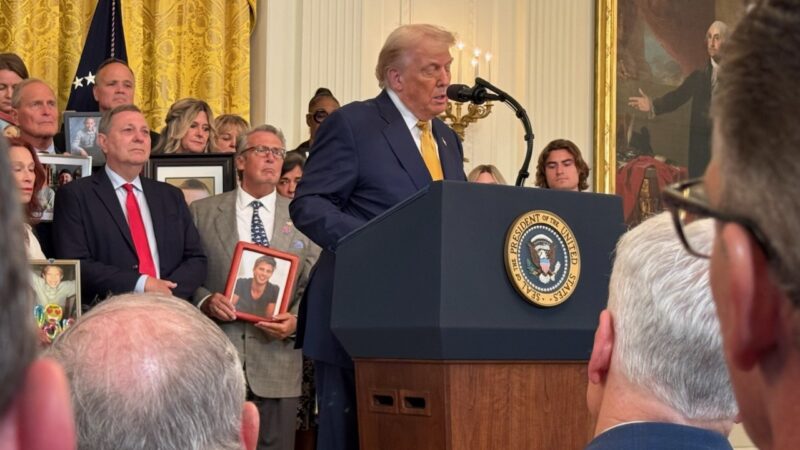
(Photo provided) New Martinsville resident Diana Estep stands in the middle of the second row behind President Trump as he talks about the HALT Fentanyl Act legislation he signed into law on July 16. Estep, whose son died from fentanyl poisoning in October 2020, has been rallying for such legislation since her 24-year-old son’s death.
New Martinsville resident Diana Estep, whose 24-year-old son Drew died of fentanyl poisoning in October 2020, attended the signing of the HALT act at the White House on July 16.
Estep was accompanied to the event by her husband Steve; daughter Bailey Celedon and her husband Oscar and their 13-month-old baby Mateo; and her sister Rebecca Kocher.
She stood on a stage behind President Trump while he made remarks about the legislation – dubbed the Halt All Lethal Trafficking of Fentanyl Act – that raises the penalties against people who deal the drug and those who manufacture it as well.
Since her son’s death, Estep has been calling for tougher penalties along with other families who have lost loved ones to the drug. They even marched and rallied in Washington, D.C., for it.
She said her son struggled with his mental health for years and tried to self medicate, leading to his addiction to illegal drugs. He tried several times to overcome his addiction and was stuck in a cycle of being clean and sober and then using again. The last time he planned to go back to rehab he first used what he believed was heroin so he could register a positive urine test; however, it turned out to be fentanyl and killed him instantly.
The man who sold him the fentanyl was convicted and is serving a prison sentence. But Estep does not want anymore families to go through what she and her family has gone through.
“This doesn’t bring our son back. Our pain is never gone. We’re doing it to warn others, so that you don’t have to live the rest of your life like we do,” she said.
Estep described being at the White House as surreal.
“It’s hard to put into words. Being at the White House and seeing the beauty of it. The workers in their uniforms. The president coming into music being played. Being there with other bereaved angel families … Everybody there, the staff, was so accommodating and sympathetic.”
After the signing she spoke to the president.
“He commented on my son’s picture. He said he was a beautiful boy. It was quite an experience,” she said.
Now that fentanyl is classified as a Schedule I narcotic, Estep is hopeful lives will be saved and that law enforcement and prosecutors across the country follow the new law.
Estep said her husband belongs to a group, Fentanyl Fathers, who aim to get fentanyl education in schools. Children, she said, need to be educated sooner about how dangerous the drug is before it is too late.
Estep noted there is a stigma still attached to people struggling with addiction, which makes it harder for people to overcome it.
“That’s not the person. That’s the disease. … I know he didn’t want to die,” she said of her son. “It’s a double edged sword. He would use it to numb the pain, and then when he would come back and remember all he did while under the influence. … It’s hard to face that. It’s like being two different people. It’s a cycle of clean to not clean; being two people over and over. They tell themselves they’ll never do it again.”
Your Community
Cat Condo Construction Completed

Unique Home Being Demolished