Paden City High School Future in Judge Wilson’s Hands
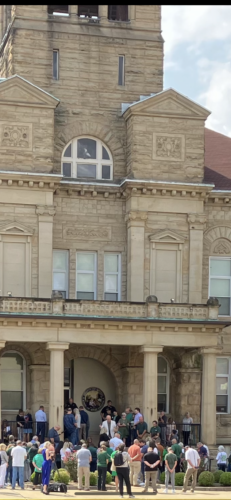
Paden City residents bow their heads in prayer for their school in front of the Wetzel County Courthouse.
A large group of citizens mostly from Paden City converged on the Wetzel County Courthouse and entered the courtroom in a quiet manner on Thursday, July 25.
Within moments every seat was occupied. At 4 p.m. the Honorable Judge C. Richard Wilson entered the courtroom. He began by explaining the case before the court that day was an important issue for both parties with a great deal of information and witnesses to be heard. He expressed hope that all present could be patient with the process and remain respectful.
For nearly seven hours, Judge Wilson and those gathered in the courtroom sat intently listening to Attorneys Will Lorenson and Ken Webb from the law firm of Bowles and Rice LLC. representing Wetzel County Superintendent of schools Cassie Porter and Teresa Toriseva and Mr. Josh Miller of the Toriseva Law Firm representing the plaintiffs from the community of Paden City. Representing the WVSSAC were Attorneys Mr. Gangy and Mr. Wayne Ryan.
The First order of business discussed was the temporary restraining order that was issued by Judge Wilson that reopened the high school and was set to expire on Friday July 26. The question was what would happen if Friday’s ending date for temporary injunction were to end. Judge Wilson explained that the issue would be addressed before the end of the day’s proceedings.
The hearing began with the plaintiff’s calling their first witness to the stand, Josh Billiter, supervisor of Paden City’s Water Department. Plaintiff’s attorney Mr. Miller explained Billiter’s role was to provide expert testimony concerning the water in Paden City, and he would also speak on the effect of the closing of the school on his family. Billiter explained he has worked for the city for 13 years, and he holds a Class 1 Water Operators License. He noted he was there to speak on water, and not the issue of vapors in school. He explained that in September of 2013, it was discovered the water being drawn from Paden City’s #2 well had a concentration of 9.92 micrograms (µg) of dry-cleaning fluid (PCE) resulting in the closure of the well. He said In 2020 the stripper plant came online to remove any contaminants that may be in the groundwater from wells #1 and #3. It operated until an incident in 2023 when the stripper failed for 14 hours which led to contaminated water entering the system.
Billiter then spoke on the effect the school closure had on his household and family. He explained it was especially difficult for his daughter who is a senior, and a member of the band. Attorney Webb questioned Billiter If there was vapor intrusion which entered in the school, and did he recognize Mrs. Porter had the authority to close the school for health and safety reasons. He answered, she did.
Next to testify was Mr. Doug Snider, a graduate of Paden City High School in 1991. He explained he graduated from Marshall University with a bachelor’s degree in science and industrial hygiene. Mr. Snider was presented on the view screen as an expert witness in volatile organic chemicals (VOC). However, He explained he had no expertise in PCE’s. The Judge ruled he could be considered an expert witness. Mr. Snider explained according to a report from TETRO TECK the exposure inside the school was negligible. He referred to maps and data and explained the sub slab concentration was 20.7 micrograms per cubic meter (µg) as tested in 2020.
He spoke to different test results and levels of PCE’s. He was then asked about mitigation of vapors similar to RADON. He explained fans could create circulation and could be used to remove any lingering contaminates. He recommended additional testing at different seasons of the year be taken into consideration. Mr. Snider also explained that he believes no fans are necessary, due to the fact the levels of contamination did not rise to a level to pose a health hazard.
Plaintiff’s Attorney Miller then called Wetzel County Superintendent Cassie Porter to testify. Miller said, Mrs. Porter, you announced the closure of PCHS on June 12th, effective July 1.
Mrs. Porter explained that under WV Code 18.410, Sub part 5, it was in her authority to close the school for health and safety concerns. She was then asked how long is temporary? Porter stated temporary is possibly 2025, when additional EPA testing is concluded. Attorney Miller, stated the EPA states there is no unacceptable risk, to which Porter responded, “I feel there is a risk.”
During testimony Mrs. Porter explained that she is an expert on caring for and educating students, and beginning in late August of last year, she began trying to find answers to having in her charge a school campus that sits on a Federal Superfund Site. Porter said, “I found that I could not remove the risk, so I removed the children.”
Attorney Miller explained that on June 12th, February’s testing results were not available to show any additional problems with PCE levels, and yet you closed the school on July 1. Mrs. Porter replied, “I am Superintendent of Wetzel County Schools I am not a spokesman for the EPA.”
Attorney Lorenson, representing Mrs. Porter posed the question to her whether BRIM insurance coverage includes pollutants and chemicals in the schools. Porter answered no. She again explained it is her hope to reopen in the fall of 2025, but only after additional testing and mitigation of the site renders it safe.
Attorney Miller once again questioned Mrs. Porter as to her actions on June 12th in reference to February’s testing results. Miller: At this point the chemical, benzene was added to the discussion. Mrs. Porter repeatedly explained, her expert witness will speak to the question of benzene.
Miller then called his next witness to the stand Mr. Eric Hayes from Paden City. He explained that his son Dalton was a student at Paden City, and he felt the school was a place his son was comfortable and not bullied as he had been in other schools. Attorney Miller asked how he found out about the closure. Mr. Hayes explained that his son learned it from an email received by a teacher.
Mr. Webb, attorney for Mrs. Porter asked Mr. Hayes If he knew benzene was a known carcinogen. Mr. Hayes responded, he understood.
The Plaintiff’snext witness to be called was Dalton Hayes, a junior at Paden City High school, and member of the band. He began by stating going to Paden City saved his life. When he found out Paden City was closing he said it was devastating.
Dalton was asked by attorney Webb: do you understand that Mrs. Porter has an obligation to do the best for everyone? Dalton responded he understands she does.
Attorney Webb then asked Dalton if he knew attending Paden City High School would expose him to chemicals? Dalton explained he accepted they would not be harmful to him and he would be attending with family. Life is full of risks.
Next to be called to by Miller was Bill Bell, a teacher and city councilman for the town of Paden City. Mr. Bell was asked if closing the school would make a difference in the town and how it affects him? He stated that he loved teaching and his students. He spoke about how the closing of Sistersville’s High School had a devastating effect on their community. He felt if PCHS closed, it would do Irreparable harm to the community and students.
Attorney Webb stated, Mr. Bell, your high school has tested positive for benzene, do you understand that is harmful? Mr. Bell explained he understood that benzene is harmful, but he went on to explain that in Mrs. Porter’s letter of June 12th, there was no mention of benzene being a concern.
Next to take the stand for the defendant was Mr. Mike Whitlow, state director of school facilities for the past three years. Mr. Whitlow explained that the state and county students have the right to gain a good education. And sometimes during that process students have to be relocated and any disruption can be harmful but necessary.
He was then asked how many school facilities he manages in the state. Mr. Whitlow responded 650. He was then asked how many sits on an EPA Superfund site, his response was none. He was then asked how many Superfund sites are within 500 feet of a school? He again responded none. He was then asked; any other schools have issues with chemical exposure? He again responded, none.
Mr. Whitlow was then asked when the state was made aware of this situation. Mr. Whitlow responded that during the city’s water crisis last year, Mrs. Porter requested information as to how to protect students in PCHS. We at the state level soon realized when the health report came out, how far it was between testing, and a lot of other unknowns, the situation had become unnerving. We were aware the risk was unacceptable, and there is evidence of how seasonal changes and flooding can affect the problem. He was asked if any other school is being monitored for chemicals, Mr. Whitlow stated, No. He said testing results take months to return, that creates little or no accountability.
Mr. Whitlow said Mrs. Porter has kept in touch with the state board and shared knowledge of the situation in order to have a better risk management plan.
Attorney Webb asked, does the department of education support Mrs. Porter’s action of temporarily closing the school with chemical exposure below actionable levels, and do you support Mrs. Porter’s decision, Mr. Whitlow replied, yes.
Attorney Miller’s question for Mr. Whitlow, did you hear Mrs. Porter’s testimony. Yes. Attorney Miller: She closed the school because it sits on a Superfund Site. Yes. Attorney Miller, Health condition report was not in play, benzene was unknown. Mr. Whitlow replied, that is correct.
The next witness was Mrs. Porter’s expert. Mr. Phillip Simon, a chemist. Simons appeared by televised link. Mr. Simon explained he had been working in this field for 42 years. During that time, he has investigated hundreds of sites to determine risks and advise on risk management plans.
Mr. Simon explained how a location is added to the national Superfund Site register and placed on a priorities list. He noted that Paden City’s site was added in 2022. He was then asked, where the location is. He stated the EPA documents state it is on a dry cleaner site east of the high school. He also explained the chemical plume has not been controlled or mitigated.
Mr. Simon went on to explain the issues with PCE and that mitigation of a site is only the first in a nine-step process. Mr. Whitlow explained the chemical could have acute effects or chronic effects. And is considered a human Carcinogens. He explained that limits or regulatory numbers may change over time due to an increase of knowledge and a chemical’s possible long-term effect. He stressed that different people have different tolerance for any given chemical. He went on to explain the maps given to him in evidence show there are two plumes below the site. One is in the groundwater and the other is in the unsaturated soil. He then went on to explain his review of sampling maps from inside the school.
Mr. Simon first explained sampling data from below the floor gives an idea of the amount of contamination in the unsaturated soil, which could enter into the building through cracks in the foundation. He also pointed out the chemical in question is five times heavier than air and would remain low in the building.
He then explained the results of the tests taken at various locations in the school. Thirty-nine compounds were found in multiple sampling data. At 63 locations the contamination was found to nearly exceed, or exceeded levels of concern. Twenty compounds are known carcinogens. Mr. Simon explained Toxic VOCs in this school’s air need to be given attention. In particular, Benzene and Methylene Chloride along with six other chemicals.
Mr. Simon was asked, where do these compounds come from and are they related to the dry-cleaning business? He explained that these compounds are associated with compounds found in fuel from years past.
Mr. Simon was then questioned by Attorney Miller, why hasn’t the EPA addressed these compounds? Simon pointed out that the EPA first came to the site with the understanding of the problem related to the dry-cleaning chemical exposure. They will address other issues as they deal with the primary chemical designation of the Superfund site.
A long discussion took place as Mr. Simon tried to explain that working with chemical exposure levels is not an apple for apple comparison. Chemical exposure in a dry-cleaning business for employees are different in that levels are established for a workplace environment, and proper safety training and measures are provided. That same chemical in an industrial site will be looked at differently and given more factors in that it can be present inside or out. And levels for a school or day care center are totally different. Children can’t be exposed at any level due to their bodies growing and any exposure could have a long-term effect particularly, if cells are damaged genetically.
At this point in the hearing all sides informed Judge Wilson they had completed their presentations. The early issue of extending the temporary injunction was settled, moving it until August 1st.
Judge Wilson then spoke to the gathering and thanked them for their patience and understanding during the long process. He assured them he understood this was an important issue for the community, school, students and the school administration. He gave the lawyers until Monday to submit final writs and he planned to have a decision by midnight Thursday, August 1st. The hearing was dismissed
It should be noted that an estimated 120 attendees were inside the courtroom, and that many and possibly more were waiting outside patiently. Bailiff and Deputy Chuck Tennent explained before the hearing began, he had anticipated this to be the largest gathering within the courthouse, since the landfill hearings, over 30 years ago.
Local News

Smiling Faces
From Riverbed to Recovery